
Skip to content

Next Steves

Coming up with the idea is the easy part. Finding someone you'd actually start it with isn't.

Next Steves is something we've done at Yellow Door since 2016: put the people who can build things next to the people who know what to build. Once every two or three months, in a room, face to face. In between, online whenever you like.

A CV tells you almost nothing about what actually decides whether two people can work together: how someone argues, how much uncertainty they can stand, why they want this at all. You only find that out by talking. We arrange the talking.

Next evening: 24 September, 18:30 Moscow, Strastnoi blvd 12, c.1.

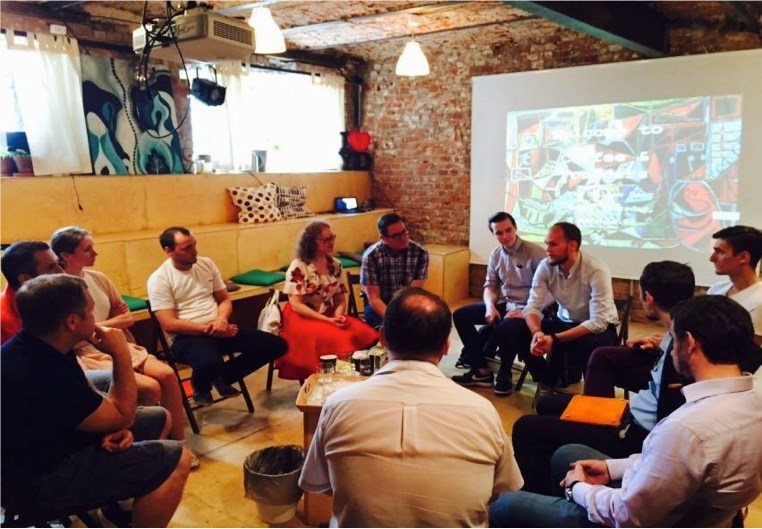
A conversation on the yellow sofa at Yellow Door
Strastnoi 12 - one of the evenings

Three ways in, one card for all of them

Some people are happy to show up and talk to twenty strangers in a row. Others would rather look first and see who is actually out there. And some meet people best over coffee on a Thursday, with no format and no timer. All three work, and nothing has to be filled in twice.

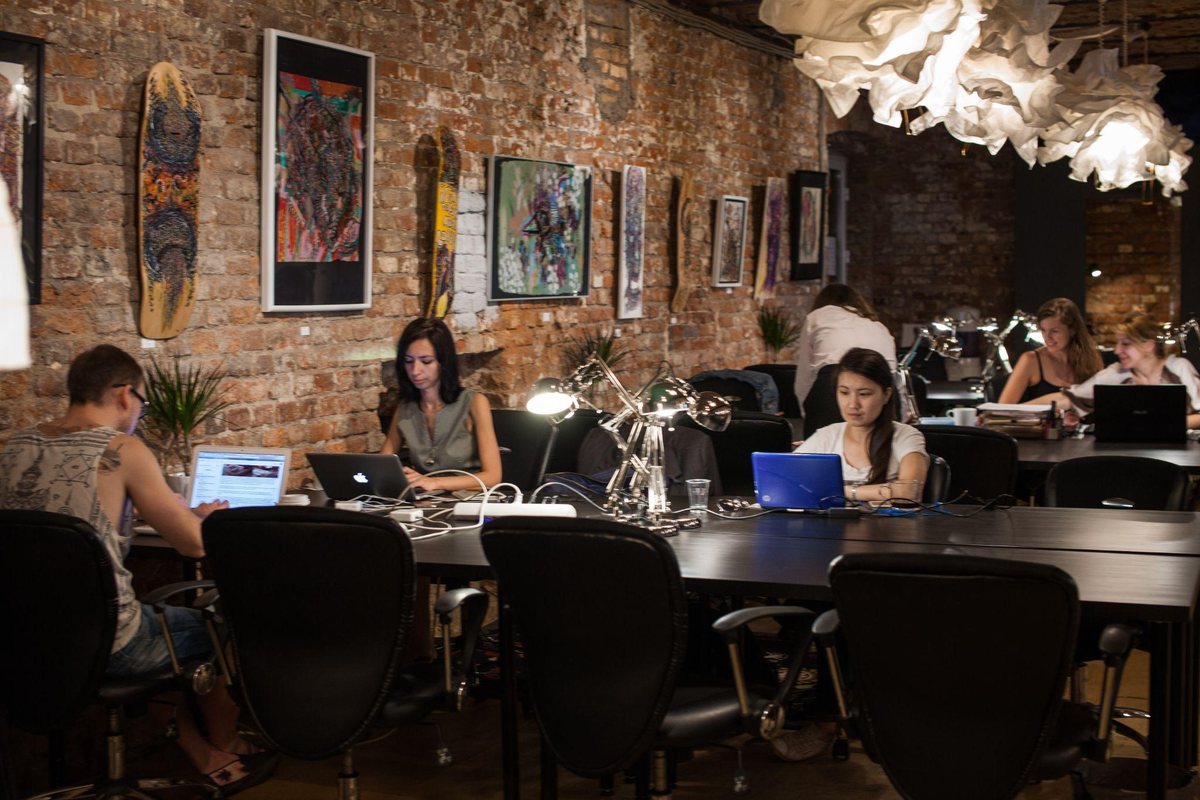
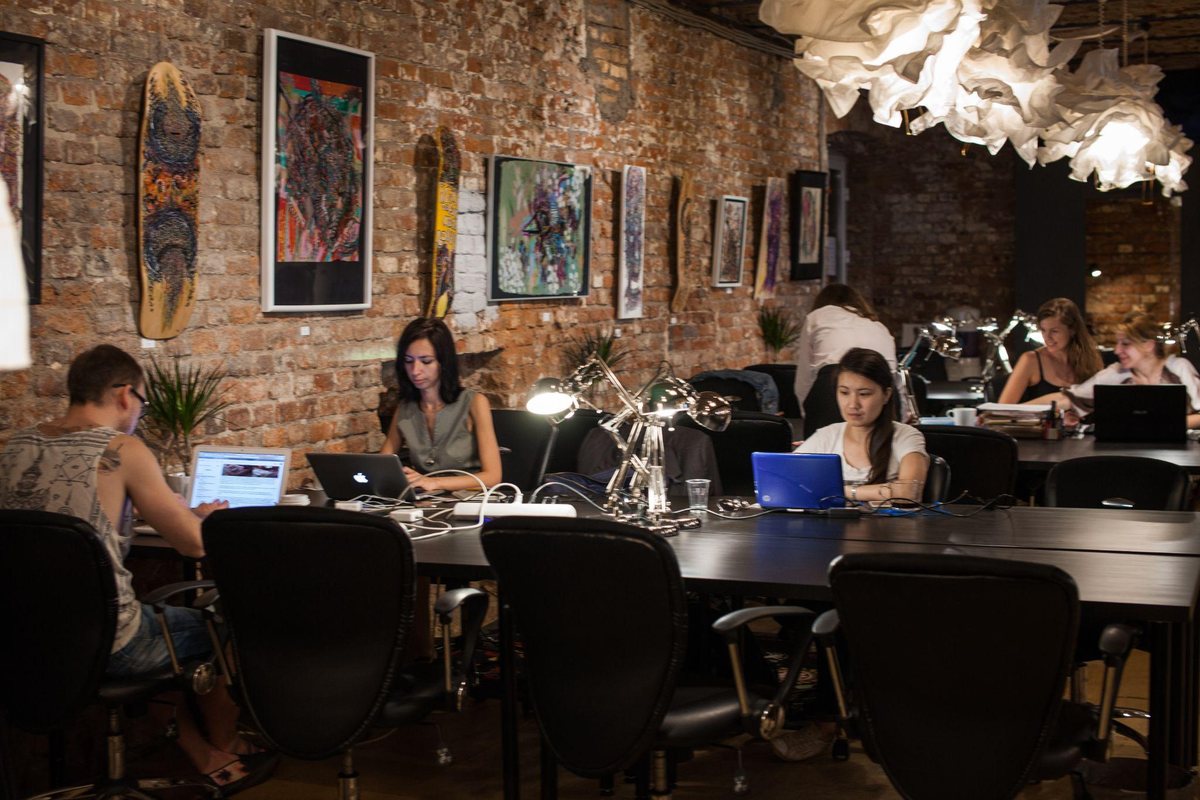
The Yellow Door coworking space

The room (online)

Fill in a card in about ten minutes, see who else is looking, and mark the people you'd like to talk to.

  • Interest is only revealed when it is mutual
  • You can look quietly for as long as you like
  • One card for the room and the evening alike
Go to the room
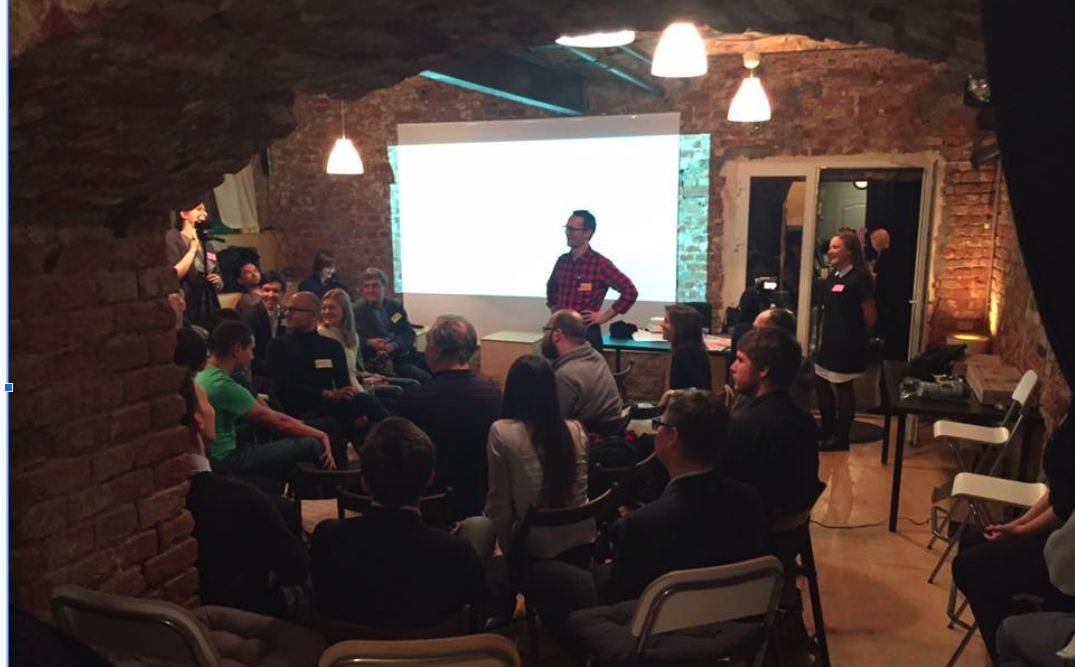
A conversation in the round at Yellow Door

The evening (offline)

Every two or three months at Yellow Door. Eight to twelve minutes per conversation, then a bell, then you move.

  • 40 seats, screened by hand
  • Same prompts, real timer
  • Mutual choices sent out the next day
See the dates
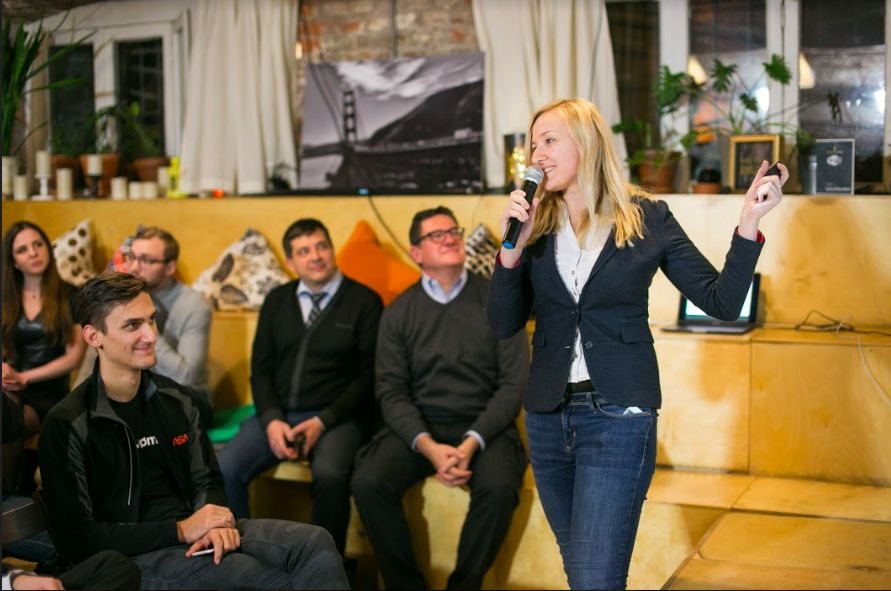
Guests at an evening

Founders Coffee (no format)

Thursdays on Strastnoi, every week since 2011. No matching schedule at all: just founders, coffee and conversation. It produces as many pairs as the evenings do, only slower and more quietly.

  • You can simply turn up, no application
  • Every week, so there is no rush
  • Your card gives context if you want to continue
Come on a Thursday

Why "Steves"

Two stories usually told as flashes of genius. Both of them start in the dullest way possible: someone introduced two people.

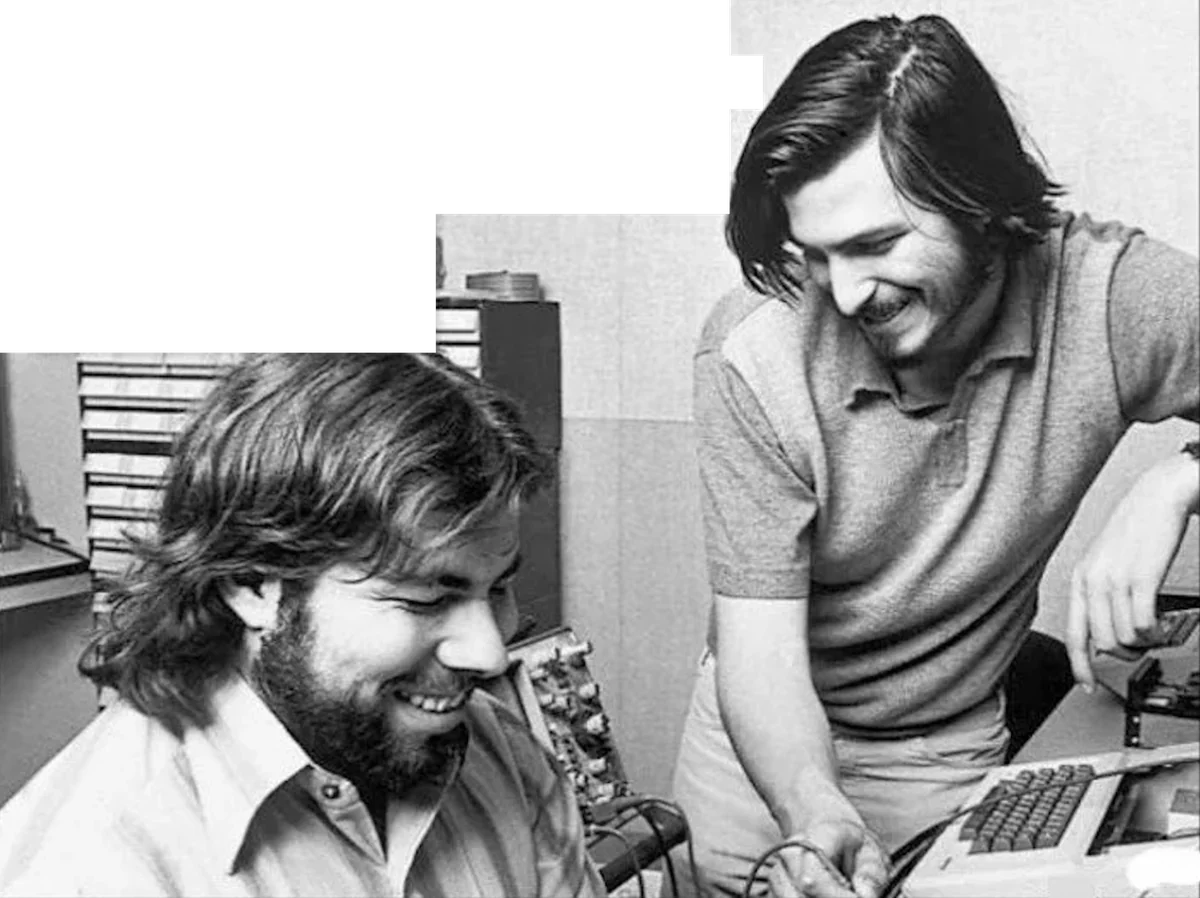
Steve Jobs and Steve Wozniak, around 1975

Steve no. 1
builds the impossible

Steve no. 2
sells the future

Jobs and Wozniak, ca. 1975. Photo: Apple Computer

Sunnyvale, 1971

A mutual friend decided these two should meet. One was 21 and could build anything out of a handful of chips. The other was 16 and already knew what the future should look like, and what it should cost.

First came pranks, Dylan bootlegs and a not-entirely-legal box for free phone calls. Five years later, the Apple I in a garage. Neither of them gets there alone.
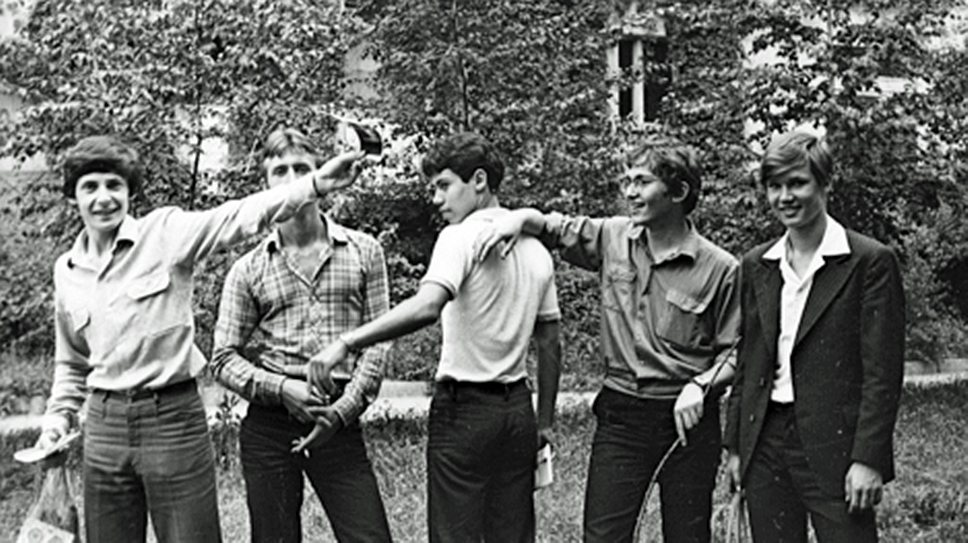
Classmates at the Republican physics and maths school in Alma-Ata, late 1970s
The physics and maths school in Alma-Ata, where the two of them met
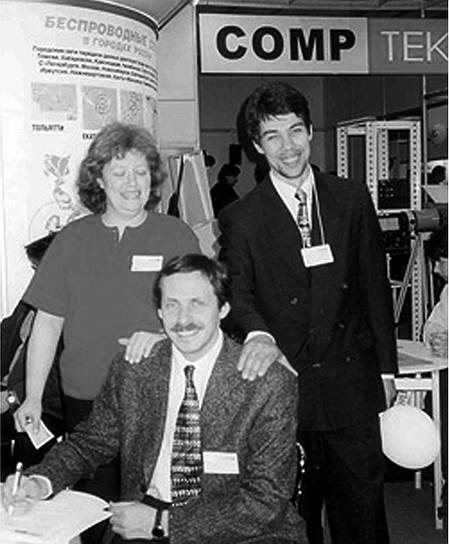
The Arkadia / CompTek stand, 1990
Arkadia, 1990 - the company the search technology grew out of
ЯndexThe Russian "Я" plus index, 1993

Alma-Ata, the physics and maths school

Ilya Segalovich and Arkady Volozh met as schoolboys at the Republican Physics and Mathematics School in Alma-Ata. Their paths split after school, met again in Moscow, and in 1993 they coined the word Yandex - "yet another indexer", with Volozh proposing the Russian letter "Я" up front.

Segalovich became the CTO, Volozh the CEO, and they founded the company together in 2000. Two people again, very different again, a school introduction again.

We decided to stop leaving introductions like that to luck.

How an evening runs

No wandering around with a glass and a stack of cards. There is a schedule, a timer, and the same questions for everyone. The evening comes in two versions: "light" - quick rounds, many meetings, and "hard" - fewer, longer, on a real project.

  1. 1

    Apply

    Tell us what you can do and who you are looking for. People read it, and everyone gets an answer.

  2. 2

    The room

    We put it together so everyone has someone worth talking to. Roughly half builders, half everyone else.

  3. 3

    The conversations

    Eight to twelve minutes, the same prompts for everyone, then you move. By the end you have met everyone worth meeting.

  4. 4

    Choosing

    At the end, everyone quietly notes who they want to continue with. Nobody learns who passed on them.

  5. 5

    After

    Matches get each other’s details and a suggestion for a small two-week experiment together.

A talk under the brick vault at Yellow Door
Guests at an eveningThe Yellow Door coworking space

Strastnoi blvd 12, c.1 - since 2011

What you'll actually talk about

The prompts on the table. They're not clever. They're the things people usually discover about each other six months in.

Which problem will still interest you in a year?

What are you noticeably better at than most people?

What do you definitely not want to do yourself?

How much uncertainty can you honestly live with?

When you disagree, how should the decision get made?

What could the two of you build in two weeks to find out?

What happens to your card

The card you fill in here is the very beginning. After that it lives in the Yellow Door ecosystem: Founders Coffee on Thursdays, the Night Climbers mentor network, the three-month Intensive at Labs, and for the ones that work, the Innov8 Global Ventures fund.

Which means applying to a matching evening and entering our pipeline are the same action, with nothing to fill in twice. The closed mentor order, the Fencing & Jousting Society, comes much later and only by nomination - usually to people who have walked this path themselves.

Your card is visible to you, to us, and to people you have matched with. We do not publish it and we do not sell it. Privacy

The path is not a straight line, and that is fine. You can reach the Intensive and go back to the Room because you are missing a technical co-founder. A pair that separates is not a failure, it is a year saved.

  1. The card

    Ten minutes. What you do, who you need.

  2. Room or evening

    Online, in person, or both.

  3. A match

    Only when it is mutual. Then you get each other’s details.

  4. A two-week experiment

    A trial-project template and a table at the coworking.

  5. Founders Coffee

    Thursdays since 2011. Turn up as a pair.

  6. The Night Climbers

    The mentor network: sessions on demand, masterclasses, teardowns.

  7. The Intensive · Labs

    Three months of preparation for going global.

  8. The Advisory studios

    Sales, ops, fundraising, PR, tech, design - when you need hands.

  9. Innov8 Global Ventures

    For the ones that work: money, a board, the next rounds.

Upcoming evenings

Evenings sit in the general Yellow Door calendar. Seats are limited, because we assemble the room by hand to keep builders and business roughly even.

24 Sep

Evening no. 7 - "light"

Strastnoi 12 · 18:30 Moscow

Open
3 Dec

Evening no. 8 - "hard"

Strastnoi 12 · 18:30 Moscow

Soon
Feb

Campus edition

Partner university

In the works

Dates can move by a week. We'd rather wait than run a lopsided room.

Application

Five minutes. We reply within a week.

A person reads this. Sometimes we say no - that's about the balance of the room, not about you.

We can run it at your place

We produce Next Steves for people building a founder community around them: accelerators, universities, hubs, corporates. We bring the method and assemble the room together with you.

Accelerators and incubators

Sturdier teams in the portfolio, and a real pipeline before the next intake.

Universities

Introduce the IT faculty to the business school and the designers. They are usually in neighbouring buildings and have never met.

Hubs, cities, development agencies

When the goal is density of connections rather than a count of events.

Corporates and institutes

So internal expertise turns into teams instead of slide decks.

What's included: programme design, the application form and screening, matching logic, facilitator materials, the run of the evening, and the whole mutual-choice process afterwards.

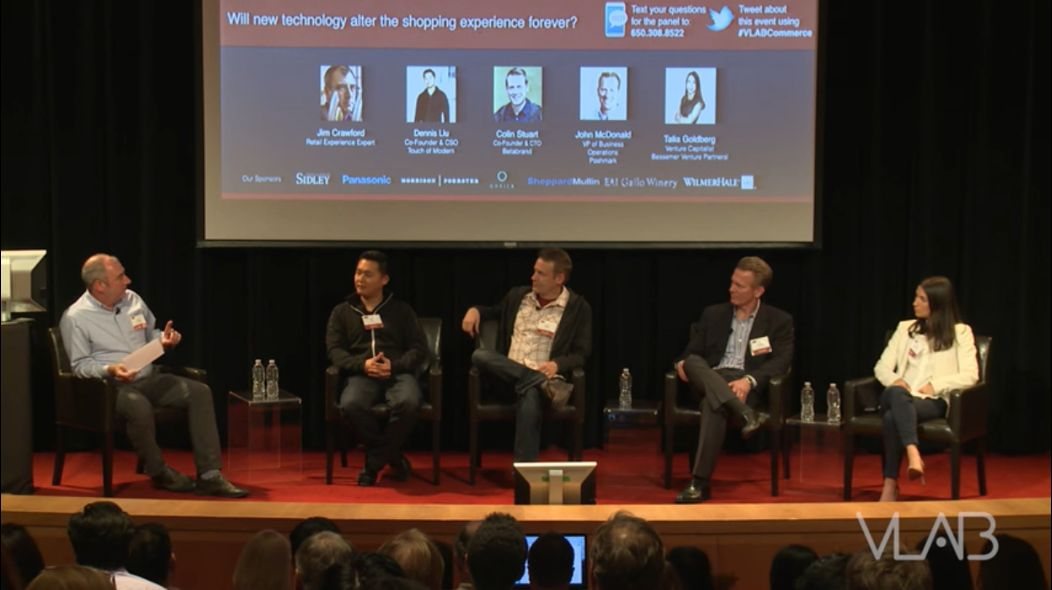
A panel at one of the events

Hosting enquiry

One-off or as a series. A single evening or a whole season.

Know someone who belongs here?

Almost everyone here came because somebody brought them. That is exactly how both stories on this page started: Apple and Yandex alike began with one person introducing two others.

TelegramWhatsAppVKEmail

Your link tells us who brought them, and it stays on their card. An invitation costs nothing and commits no one.

Partners and sponsors

A few dozen hand-picked engineers, researchers and operators in one room. Partners are what let us keep it selective instead of ticketed.

Talk to us about partnering
Venue and productionhost an evening
Credits and servicescloud, legal, tools for matched pairs
Food and coffeethe evening runs on it
Media and communitiesso the right people apply

Since 2016

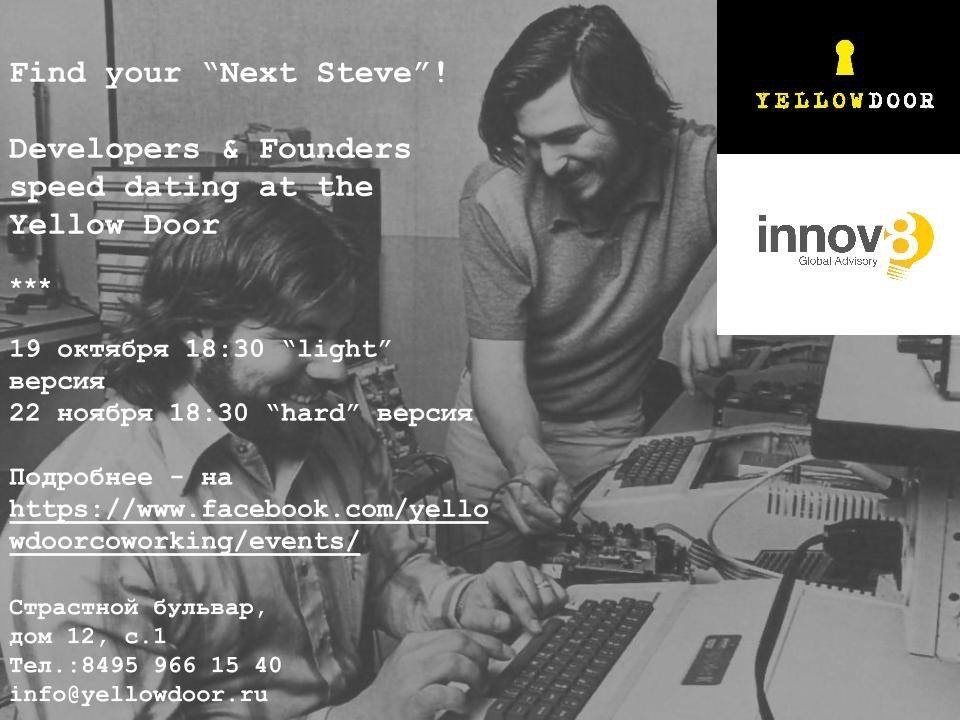
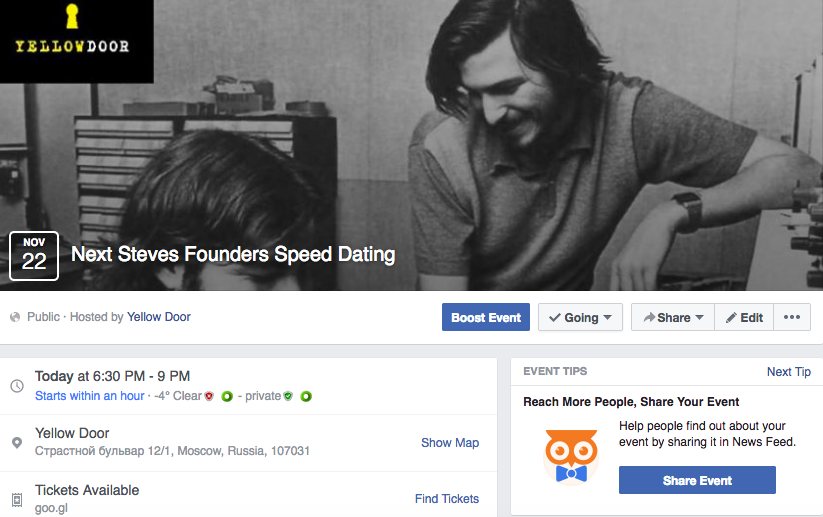
We first did this in 2016 under a fairly blunt name: "Find your Next Steve!". There were two versions, light and hard, and the difference was how directly you were allowed to ask about money and equity.

Now it's back as a standing programme: same conviction, tidier method. The name is a warm nod to Jobs and Wozniak, not a promise to manufacture you a unicorn.

The 2016 poster
The 2016 poster
Event announcement, 22 November 2016
Announcement, 22 November 2016

Short answers

Do I need an idea? +

No. Plenty of people arrive with a skill and a question rather than a pitch. Ideas are not the scarce part.

Do I need to code? +

No. The room is deliberately mixed: engineers, product, design, researchers, sales and operations.

Is this only for first-time founders? +

No. Experienced founders looking for their next partner tend to raise the level of every conversation in the room.

How do you screen? +

People read the applications. We look at readiness to actually do it, real skill, and whether the room holds someone worth your evening.

How long is each conversation? +

Eight to twelve minutes. Long enough to tell whether you want to continue, short enough not to get stuck.

What if interest is not mutual? +

Nothing awkward happens. Choices are private, only matches are shown, and there are no popularity scores.

Can an existing team come? +

Yes, if you are missing one person. You apply together and rotate together.

Are online and offline separate sign-ups? +

No, it is one card. The evening is just the same room at a faster speed.

Would you run it in another city? +

Yes. The method, materials and facilitation are ours; we build the room with you. Use the form above.